This week, Juliette’s suggestion of selling advertorial spaces to bookstores is exactly what I have been thinking over the past few weeks. Because I think we are mainly targeting at local book lovers, putting ads on our website will sound more cost-effective to bookstore owners.
Moreover, I really like the website AddThis, which Christine shared with us. It generates sharing code that we can post on our web pages so that user can share the content elsewhere. It’s really easy to use and totally free of charge. I think I have been seeing those buttons everywhere, and finally I know where they come from.
Christine also brought us another wonderful news that she may be able to get us free hosting. We will only need to pay for the domain name. Hopefully, we will have opportunity to discuss this together next week.
Thursday, 25 March 2010

Friday, 19 March 2010
Wednesday, 17 March 2010
Week 3
My research results for our group project this week are as follows.
uI think this website is similar with the one we are going to build, although we are not going to sell books as this site does.
uI really like the search engines that help users to look for the nearest bookstores and events.
uOn the left side of the homepage, the link under “love your local” directs users to a sub-site highlighting events and activities within independent bookstores across
uSpeaking of independent bookstores, we can actually get their locations and other contact details from Leading Edge Books, which is the website of
uThe bookstore reviews from this site are probably too short and too ad-like for this subject. We certainly need to write better reviews.
uI found a bookstore review article here, worth checking out.
uThe “Book Launches & Author Events” section looks like what we are going to do as part of our project.
- The using of Google Map
uI would highly recommend using something like Google map in this project.
uGoogle map allows us to tag a particular location, write reviews and publish the map on our own website. Such service is very easy to use and totally free.
Friday, 12 March 2010
Week 2
Our initial idea for the project was to build a website for book clubs in Australia. After this week’s discussion, we decided to shift the theme to a website reviewing local bookstores around Melbourne. Also, we will have a calendar that allows users to check out the upcoming literary events in Melbourne.
This bookstore-reviewing site will cater the interests of the local book lovers and provide people with an easily accessible guide on where to look for books on particular subjects. So far, there is no such website available so our site is going to be unique in the market.
This bookstore-reviewing site will cater the interests of the local book lovers and provide people with an easily accessible guide on where to look for books on particular subjects. So far, there is no such website available so our site is going to be unique in the market.
Friday, 5 March 2010
Week 1
As a requirement of Advanced Editing for Digital Media, I will be working with several other fellow students to construct a website and send it live at the end of this semester. In first week’s class, we looked at three websites constructed by students from previous years—
I personally am mostly impressed by UpUrAlley, which I think is more commercialised than the other two.
UpUrAlley is targeting specifically at people who are interested in life on
I really like their idea of encouraging local businesses to buy advertorial spaces. The local businesses would know their ads could reach exactly their potential local customers and hence their ads will be more cost-effective.
Their using of TweetGrid is another thing I would like to praise, because such function allows browsers to interact and contribute to UpUrAlley in real time.
Chocrocks obviously has more beautiful page design and more informative contents. I really like the navigation bar on the right side. Although I think it could be shorter so that users do not have to scroll down to see the whole page. Making a simple drop-down menu should do the trick.
Monday, 9 November 2009
Assignment3 Part2 Article4
College Students Drowned to Save Two Kids
What We Have Learnt from This?

What We Have Learnt from This?

More than ten students from
Picture 1

Picture by CCTV
According to some reports, the three students drowned could have been saved by local fishers who refused to carry out any rescue action but chose to look on with folded arms. After ensuring the students were sure to be drowned, the fishers asked the other students and the college teachers (who arrived there later) for 36,000 RMB (around US$5,000) in total to salvage the bodies out of the river (see Picture 2). The desperate students and teachers had to went back home to collect or borrow money in order to take back the bodies of the three students. Eventually, the fishers agreed to return the bodies for 33,000 RMB (more than US$4,800) after the kneeling and begging from the students and teachers who couldn’t come out with more money.
Picture 2

Picture by Xianming, Liu
According to the further investigations carried out by the local government, the fishers who asked for money to salvage the bodies actually rely on such business to earn a living. The water around that bay is extremely dangerous for unprofessional swimmers, and many people have drowned over decades because of the strong undercurrent and eddy current in the area. Thus a small group of local fishers decided fishing dead bodies was a much more profitable business than fishing fish.
The incident has evoked strong criticism and intense debate within hinese society recently. Many people said the fishers’ inhuman behaviour was inexcusable and unforgivable. And it is definitely difficult to believe such horrible thing can happen in today’s civilised society. Moreover, some people said the college students shouldn’t try to save others if they didn’t know how to swim themselves.
But apart from feeling sorrow and angry, what should we actually learn from such tragedy? How do we make sure such thing won’t happen again in future?
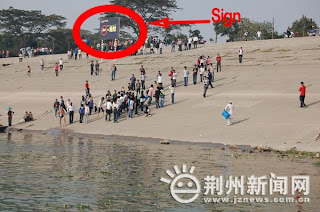
First, there is a huge sign on the bank saying it’s a dangerous area and swimming is strictly prohibited (see Picture 3), then why the kids were still swimming there? Why the college students were having picnic so near to the water? Shouldn’t they be taught to follow the instructions on the sign? Also, why the kids were there by themselves without adults supervising them?
Picture 3

Picture by JZnews
Second, it’s very worrying that most students did not even know how to swim when the tragedy happened. Swimming is such a basic survival skill but usually it is not a compulsory subject in Chinese high schools. Instead, new students in high school or college are required to take basic military trainings. But aren’t swimming much more important than learning goose steps, particularly in cities near river and sea?
Third, all schools do not teach self-rescue or resuscitation measures in
Fourth, there was no river guard appointed by the local authority near the river bank. The local government didn’t even seem to have a protocol to deal with such cases. When emergency happens, people had no one to turn to. Probably this was exactly why the fishers could earn huge money from such a dreadful way—no one has been there to stop them at all.
Assignment3 Part2 Article3

Apple is busy preparing to enter the enormous Chinese market by introducing iPhone in cooperation with the second biggest Chinese telecom company—China Unicom. Although China’s approximately seven-hundred-million mobile user base seems like an inexhaustible profit source, many people doubt Apple will encounter the same predicament it faced when trying to launch iPhone in India.
In August 2008, Apple tried to sell iPhone to Indian mobile users but failed to create a market buzz. Some reports said journalists even outnumbered customers in iPhone’s launch parties in eight cities in India. There were two major factors that caused the lack-of-excitement situation. First, there was no effective marketing strategy. Second, the price was higher than what Indian users were willing to pay.
Apple definitely has learnt its lessen in
Another reason for China Unicom to stay optimistic about the potential sales is that there is immense demand for iPhone in
Speaking of pricing, many Chinese media and users have been criticising China Unicom’s calling rate plans will just not work out. One of the major reasons is that most people who can actually afford the relatively expensive iPhone are using China Mobile—the biggest Chinese telecom company. China Unicom’s users are mostly younger people with lower allowance. Furthermore, users think the handsets introduced this time are crippled without WiFi, which was not allowed under Chinese governmental policy when Apple and China Unicom sealed the deal. Many Chinese users feel like they are “second-class users” to Apple when their iPhones are lack of such important function. On the contrary, iPhones sold in the black market not only keep WiFi, but are also more than a thousand yuans cheaper. For example, China Unicom is selling iPhone 3G 8GB for 4999 RMB (around US$732); while the black market price is only 3600 RMB (around US$527).
However, China Unicom claimed the subsidised price will be cheaper and even affordable for students if users sign a two-year subscription contract with the company. Users can receive an iPhone for free by choosing one of the two-year subscription agreements. The problem is to receive a free iPhone, a user has to pay 586 RMB (around US$86)every month, which is a far more expensive price than most ordinary users in
Clearly it is unwise to assume iPhone can be popular everywhere. The journey of introducing iPhone to the biggest mobile market in the world will be rugged and rough and will require a lot more effort from Apple and China Unicom.
Here’s a news clip about the launch of iPhone in
Subscribe to:
Posts (Atom)